The Simple Wave electric scooter launches today — September 2, 2026 — as Simple Energy’s first family-focused product, positioned below the One range. Known internally as the Arrive during testing, the production name is officially Simple Energy Wave. Price and final specs are being confirmed at today’s launch event.
This article decodes everything confirmed from spy shots and teasers, flags which figures are expected versus official, and maps the Wave against the Ather Rizta, TVS iQube and Bajaj Chetak — three of the most competitive family electric scooters in India right now among upcoming electric scooters 2026.
What Is the Simple Wave — And Why Simple Energy Needs It
Simple Energy built its reputation on performance. The Simple One (₹1.95 lakh) packs a 5 kWh battery and 265 km IDC range. The One S (₹1.72 lakh) offers 3.7 kWh and 190 km. The Ultra (₹2.35 lakh) tops out at 6.5 kWh and 400 km claimed range. None of these target the buyer who wants a practical, affordable Simple electric scooter for daily family commuting.
The Wave changes that entirely. It is Simple Energy’s first move into the mass-market family segment, competing directly with the Ather Rizta, TVS iQube and Bajaj Chetak — scooters that collectively dominate electric scooter India’s fastest-growing category by monthly volume.
Simple Energy is also using the launch as a platform for geographic expansion. Currently at 75 dealerships concentrated in Tamil Nadu and Karnataka, the brand targets 150 to 200 outlets by fiscal year-end — with tier-2 and tier-3 cities as the primary focus. These are markets where family buyers dominate purchase decisions and where petrol scooter replacement rates are highest.
Simple Wave Launch Date — September 2, 2026
The Simple Wave launch date is confirmed: September 2, 2026. Simple Energy officially announced the launch after months of road testing under the Arrive name. All final specs, pricing and booking details are being revealed at today’s event. Any figures in this article that predate the launch are pre-announcement estimates.
The timing is significant. The Ather Konarc — a directly competing family scooter — launched just four days earlier, on August 29, 2026, at an expected ₹1.00 to ₹1.25 lakh. Two new family electric scooters entering the market within one week of each other, ahead of Diwali, signals a fiercely competitive festive season. Simple needs its pricing to land clearly to cut through.
Simple Wave Price in India — What to Expect
The Simple Wave price in India has not been officially confirmed. ZigWheels and BikeDekho both estimate the Simple Wave electric scooter price at approximately ₹1.30 lakh ex-showroom — consistent enough to treat as the working estimate.
The internal logic supports it. The Wave sits below the One S at ₹1.72 lakh; a price above ₹1.40 lakh would leave too small a gap and undermine the family-segment positioning. At the same time, the Ather Rizta S is available today at ₹1.21 lakh with a proven platform and wider service network. The Bajaj Chetak starts at ₹96,400. Those are the real benchmarks.
On-road pricing adds 10 to 15 percent above ex-showroom — RTO registration, first-year insurance and TCS. At ₹1.30 lakh ex-showroom, most buyers should budget ₹1.48 to ₹1.52 lakh on-road. Confirm the final Simple Wave price in India with a Simple Energy dealer once official numbers are announced today.
Simple Wave Design — Comfort Over Performance
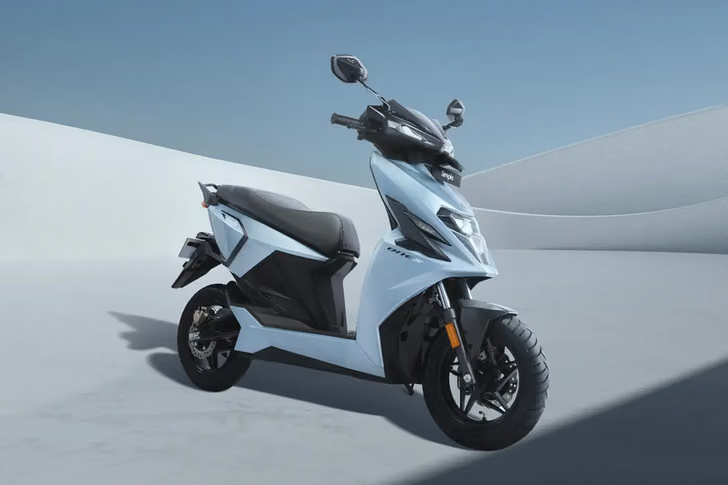
The Wave departs completely from Simple Energy’s design language. Where the One and Ultra use angular, wedge-shaped bodywork, the Wave takes a conventional, boxy form built around usability.
Test mule observations confirmed a large single-piece seat for comfortable two-up riding, a wide flat floorboard with practical carry space, and an apron-mounted LED headlamp. The left switchgear carries a navigation joystick for TFT console control — a practical touch that keeps the rider’s eyes forward during navigation.
Mechanically, it shares the One’s platform but is tuned differently. The front suspension switches to a conventional telescopic fork from the One’s upside-down unit. The rear runs twin shock absorbers instead of the One’s single monoshock — the traditional setup for a family electric scooter, prioritising comfort and pillion load capacity over handling sharpness. Braking: front disc and rear drum, standard across this price bracket.
Simple Wave Range and Battery Capacity — Claims vs Confirmed
The Simple Wave range and Simple Wave battery capacity are both unconfirmed. BikeDekho — citing a single industry source — expects a 3.7 kWh pack, the same unit used in the Simple One S. On that basis, an IDC-certified range of approximately 180 km is the most widely reported estimate.
One figure to ignore: ZigWheels lists the Wave’s expected range as 400 km. This is almost certainly a data error that copies the Simple Ultra’s specification. A 3.7 kWh single-pack scooter tuned for family commuting will not produce Ultra-class range.
The 180 km IDC figure, if confirmed, is competitive. In real-world Indian conditions — city traffic, air conditioning, two-up load — plan for 130 to 150 km of actual range. That is the 15 to 25 percent gap from IDC that consistently applies across electric scooters in India. For comparison: the Ather Rizta S delivers around 105 km real-world, the Bajaj Chetak reaches 153 km IDC on its larger variants, and the TVS iQube tops out at 212 km IDC on the 5.3 kWh ST variant. Charging specifications have not been revealed.
Simple Wave Features — What the TFT Console Suggests
The Simple Wave features confirmed from testing: a TFT instrument console, a navigation joystick on the left switchgear, and an integrated kill/start button. These hardware details point clearly to connected functionality matching Simple Energy’s existing platform.
Expected from the One range’s feature inheritance: Bluetooth connectivity, turn-by-turn navigation without smartphone tethering, and call and SMS notification alerts. Whether OTA updates, multiple ride modes or reverse assist will be confirmed at launch is unknown.
Simple Energy Wave’s connected software on the One has earned positive owner reviews — the navigation joystick implementation is consistently cited as more intuitive than touchscreen-only rivals. If the Wave carries it forward, that gives Simple an edge over the Bajaj Chetak’s basic digital display. Against the Ather Rizta’s AtherStack and TVS iQube’s SmartXonnect — both mature, widely-used platforms — the Wave will need to demonstrate comparable depth.
Simple Wave vs Ather Rizta vs TVS iQube vs Bajaj Chetak
This matchup will sharpen once official specs are live, but the pre-launch picture already gives buyers a useful starting point. Wave column uses pre-launch estimates — flagged clearly.
| Spec | Simple Wave (Expected) | Ather Rizta S | TVS iQube | Bajaj Chetak |
|---|---|---|---|---|
| Price (ex-showroom) | ~₹1.30L* | ₹1.21L | ₹1.11–1.62L | ₹96,400–1.34L |
| Battery capacity | 3.7 kWh* | 3.7 kWh | 2.2–5.3 kWh | 2.9–3.5 kWh |
| IDC Range | ~180 km* | ~160 km | Up to 212 km | Up to 153 km |
| Braking | Disc + Drum* | Disc + Drum | Disc + Drum | Drum + Drum |
| Display | TFT* | TFT | TFT | Digital |
| Rear suspension | Twin shock* | Monoshock | Monoshock | Monoshock |
| Status | Launches Sep 2* | Available now | Available now | Available now |
*Pre-launch estimates. Verify at simpleenergy.in after September 2.
The Bajaj Chetak leads on entry pricing at ₹96,400 and is on sale today with an established network. The TVS iQube offers the widest range ladder in the segment and one of India’s strongest EV service networks. The Ather Rizta S at ₹1.21 lakh is the sharpest head-to-head rival — same expected battery, comparable range — but with a wider dealer footprint than Simple currently operates.
Tips — Before You Book
Wait for the official spec sheet. Launch-day pricing may land above or below the ₹1.30 lakh estimate. A price above ₹1.35 lakh changes the comparison significantly against a Rizta available right now.
Calculate on-road, not ex-showroom. At ₹1.30 lakh ex-showroom, plan ₹1.48 to ₹1.52 lakh on-road after RTO, insurance and TCS. Build this number before comparing with competitors.
Check Simple Energy’s dealer presence in your city. The network is strong in Tamil Nadu and Karnataka, thin elsewhere. A scooter with a service centre 80 km away is a different ownership experience from one with a dealer nearby.
Consider the Ather Konarc. Launched August 29 at expected ₹1.00 to ₹1.25 lakh, it competes directly and comes from a brand with a more established national service network.
Ignore the “400 km range” figure. It is a data error found on some aggregators, sourced from the Simple Ultra’s specification. The Wave’s expected 180 km IDC is the credible figure — even that requires independent confirmation.
Test-ride before booking. Twin rear shocks versus rivals’ monoshock setups creates a noticeably different ride feel — softer, but potentially less composed at highway speeds. Know what you are buying before committing.
Frequently Asked Questions
What is the launch date of the Simple Wave electric scooter?
The Simple Wave electric scooter launches on September 2, 2026. Simple Energy confirmed the date officially after months of road testing. All specifications, pricing and booking details are being announced at the Bengaluru launch event today.
What is the expected Simple Wave price in India?
No official price has been announced. ZigWheels and BikeDekho estimate approximately ₹1.30 lakh ex-showroom. On-road cost in most states will fall between ₹1.48 and ₹1.52 lakh. Confirm with a Simple Energy dealer once official figures are live.
What is the expected range of the Wave?
Industry estimates put the Simple Wave range at approximately 180 km IDC, based on an expected 3.7 kWh battery pack. Real-world range in Indian conditions will likely land between 130 and 150 km. Disregard aggregator listings showing “400 km” — that figure belongs to the Simple Ultra.
How does the Simple Wave compare to the Ather Rizta?
Both are expected to use a 3.7 kWh battery with similar IDC range. The Ather Rizta S is priced at ₹1.21 lakh and available now, with AtherStack connectivity and a wider service network. The Wave is expected at ₹1.30 lakh with a twin-shock rear setup for added comfort. Full comparison requires official Wave specs.
Is the Wave the same as the Simple Arrive?
Yes and no. The Arrive was the internal development name used during testing phases. Simple Energy officially confirmed the production name as the Wave in August 2026. The Arrive name has been retired — it is the same scooter with the official name now confirmed.
Pricing Decides Everything — September 2 Settles It
Simple Energy has designed the right scooter for the family segment. Conventional layout, practical features, comfort-first suspension — the brief is correct and the execution looks credible from what spy shots revealed. The Simple Wave now faces the harder test: the price announcement.
The Ather Konarc at ₹1.00 to ₹1.25 lakh set a new standard four days before launch. The Bajaj Chetak holds the sub-₹1 lakh entry. Price this scooter at ₹1.25 lakh and Simple Energy enters the fight with momentum. Push it above ₹1.40 lakh and the limited service network becomes the headline instead. September 2 answers the question — update this page once official numbers are confirmed.