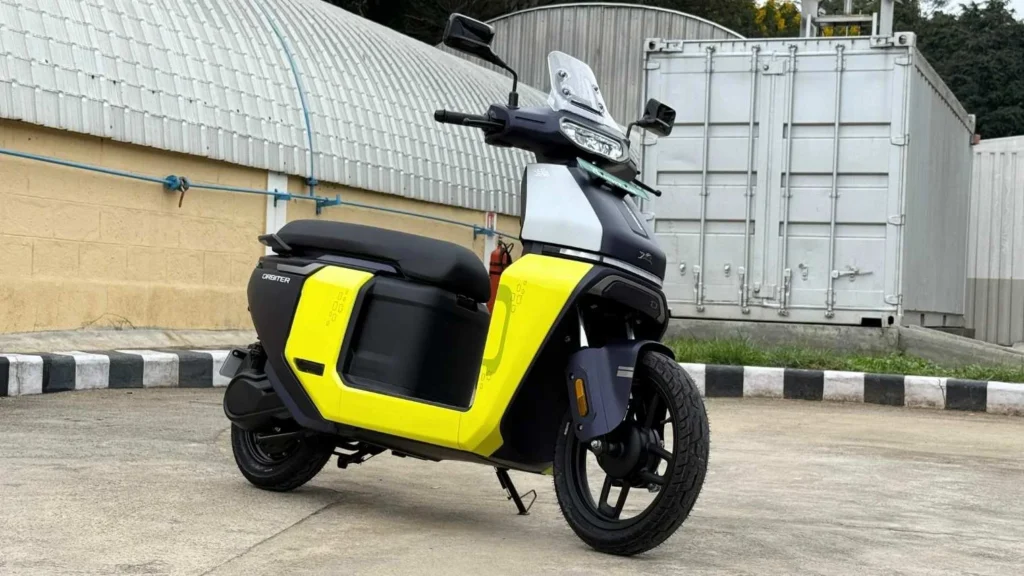
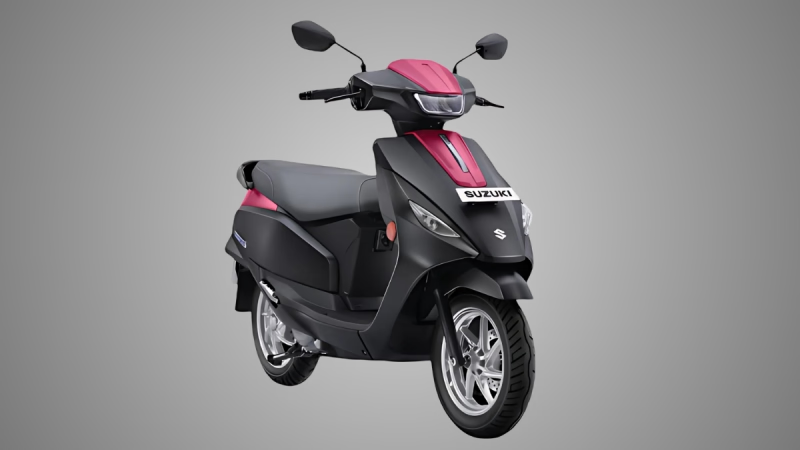
The Suzuki e-Access launched in India on January 9, 2026, at ₹1,88,490 ex-showroom, and eight months of owner data and professional reviews now exist to answer the questions a spec sheet cannot.
This is Suzuki India’s first electric vehicle, a Suzuki electric scooter built on the Access nameplate that dominated the 125cc segment for years. What follows is not a launch preview. It is a real-world breakdown of actual range per charge, daily charging cost, running cost per km and what the LFP battery means for long-term ownership in the Indian context.
What Is the Suzuki e-Access: The Brief
The e-Access carries the Access 125 nameplate into electric territory. It uses Suzuki’s in-house electric platform, called Suzuki e-Technology, with a fixed 3.07 kWh LFP battery and a 4.1 kW peak motor producing 15 Nm. Fixed battery means the pack cannot be removed for indoor charging. Buyers plug the scooter in wherever it parks. Single variant, no trim choices.
Launch price was ₹1,88,490. Current ex-showroom averages ₹1,90,761 to ₹1,95,064 depending on state. On-road in Delhi: ₹1,94,526.
The defining engineering choice is LFP battery chemistry over the NMC cells most rivals use. LFP stores less energy per kilogram, explaining the 95 km IDC range that trails rivals, but degrades far more slowly over years of use. The belt drive adds to the low-maintenance proposition, rated to 70,000 km before replacement. No chain oiling, no sprocket wear in between. This is a LFP battery scooter built for the owner who keeps a scooter for seven years, not one who upgrades in two. Electric scooter maintenance costs over a full ownership period strongly favour LFP-equipped models.
Suzuki e-Access Real World Range: What Owners Actually Get
The Suzuki e-Access real world range is the most searched question about this scooter, and the honest answer diverges significantly from the IDC claim.
IDC vs Reality
IDC-certified range (AIS-040 standard, used in India): 95 km. This is a 95 km electric scooter on paper. Real-world figures from BikeDekho’s first-ride review and bijliwaligaadi.in’s extended ownership evaluation:
Eco mode, single rider, mild city traffic: 80-85 km. Normal mode, mixed city commute: 70-75 km. Aggressive riding or higher speeds: 50-55 km.
The 26 percent gap between IDC and real-world typical use is larger than most rivals. Buyers planning commutes above 60 km daily should look elsewhere.
What Affects Range
Three riding modes (Eco, Normal and Power) directly affect usable distance. Eco mode limits throttle response and extends range; most daily commuters should use this as default. Power mode is for overtaking, not sustained riding.
Two-up riding reduces range by approximately 10 to 15 percent. LFP chemistry is thermally stable and does not lose range in hot weather the way NMC cells do, a real advantage in Indian summer conditions that aggregator specs never capture.
Practical framing from owner reports: buyers doing 35-40 km daily can charge every alternate night comfortably. The range per charge is enough for this use case without range anxiety.
Suzuki e-Access Charging Time: Home vs Fast Charger
The Suzuki e-Access charging time breaks down into two confirmed options.
Home charger (portable, standard): 0 to 100 percent in 6 hours and 42 minutes using a standard 15A home socket. Overnight charging is the practical use case for most buyers.
Fast charger (Suzuki-designated stations): 0 to 80 percent in approximately 1 hour and 12 minutes, 0 to 100 percent in approximately 2 hours and 12 minutes.
The honest caveat: some BikeWale owner reviewers from smaller cities reported no Suzuki fast charger within practical distance, making home charging the only realistic option for those buyers. Confirm fast charger availability at the nearest Suzuki dealership before purchase.
The e-Access charges slower than TVS iQube mid-spec variants and noticeably slower than Ather’s fast-charge capable models. The fixed battery means there is no removable-battery workaround. Electric scooter charging cost at home, however, is predictable and low.
Suzuki e-Access Charging Cost: The Numbers That Matter
According to the Suzuki e-Access charging cost calculation on Suzuki’s official blog, home charging cost at typical Indian residential tariffs works out as follows.
At ₹8 per kWh: approximately ₹28-30 per full charge, including a 15 percent efficiency loss.
At ₹10 per kWh: approximately ₹35-38 per charge.
At ₹12 per kWh: approximately ₹42-46 per charge.
Running cost per kilometre is ₹0.30-0.35, based on approximately 39 Wh per km consumption in mixed city riding.
The monthly comparison is the most useful figure. At 40 km per day: electricity costs approximately ₹384 per month versus approximately ₹2,100 per month in petrol for an Access 125 (at ₹105 per litre and 60 km per litre ARAI-certified). Monthly saving: ₹1,716. Electric scooter running cost advantage is significant and consistent.
The e-Access costs approximately ₹1.06 lakh more than the petrol Access 125 (₹82,185). At ₹1,716 monthly fuel saving, the fuel cost premium pays back in approximately seven months of daily use.
Suzuki e-Access Battery Life: Why LFP Chemistry Matters
The Suzuki e-Access battery life question comes down to chemistry. LFP versus NMC is not a marketing distinction.
NMC (Nickel Manganese Cobalt) batteries, used by most rivals, are rated for 500 to 800 full charge cycles before capacity degrades noticeably. EV battery life on LFP (Lithium Iron Phosphate) extends to 3,000 to 4,000 cycles before significant degradation.
Applied to the e-Access: at 70 km real-world range per charge and 3,000 cycles, theoretical battery distance is approximately 210,000 km. No electric scooter buyer reaches that figure, which means the LFP battery will outlast the typical ownership period without capacity anxiety. Suzuki backs this with a 7-year or 80,000 km warranty on both battery and motor, the longest combination warranty in the electric scooter segment. Most rivals offer 3 to 5 years.
The Suzuki e-Access battery capacity is 3.07 kWh. The LFP pack is thermally stable. Overheating-related degradation is significantly less common than in NMC equivalents. The belt drive, rated to 70,000 km, reduces service touchpoints further.
Suzuki e-Access Running Cost: Full Ownership Cost Breakdown
The Suzuki e-Access running cost across a full ownership year gives the clearest picture of the value proposition.
The Suzuki e-Access ownership review from eight months of Suzuki e-ACCESS India market data supports this annual cost structure at 40 km per day (14,600 km annually):
Electricity: approximately ₹4,600-5,000 per year.
Annual service: approximately ₹500-1,000 (belt drive and sealed motor require minimal intervention).
Insurance: approximately ₹4,000-5,000 per year.
Total annual running: approximately ₹9,600-11,000.
Petrol Access 125 at identical mileage:
Petrol: approximately ₹30,700 per year.
Annual service (engine oil, spark plug, air filter, valve check): approximately ₹3,000-4,000.
Total: approximately ₹33,700-35,000 per year.
Annual saving: ₹23,000-24,000. The ₹1.06 lakh premium over the Access 125 recovers in approximately 4.5 years. Buyers planning five-plus years of ownership will come out ahead on total cost.
Suzuki e-Access vs Key Electric Scooter Rivals
This scooter competes in a segment where price, range and charging speed vary widely. The table below uses confirmed prices and specifications.
| Spec | Suzuki e-Access | TVS iQube (base) | Bajaj Chetak | Ather Rizta S |
|---|---|---|---|---|
| Price (ex-showroom) | ₹1.88-1.95L | ₹1.11-1.19L | ₹96,400 | ₹1.21L |
| Battery | 3.07 kWh LFP | 2.2 kWh | 2.9 kWh | 3.7 kWh |
| IDC Range | 95 km | 75 km | 126 km | ~160 km |
| Real-world range | 70-85 km | 55-65 km | 95-100 km | ~115-125 km |
| Top speed | 71 kmph | 82 kmph | 73 kmph | 80+ kmph |
| Home charging | 6h 42m | ~5h | ~5h 30m | ~5h 45m |
| Battery warranty | 7 yr / 80,000 km | 3 yr / 50,000 km | 3 yr / 50,000 km | 5 yr / 60,000 km |
| Running cost/km | ₹0.30-0.35 | ₹0.25-0.30 | ₹0.22-0.28 | ₹0.25-0.30 |
The Bajaj Chetak at ₹96,400 starts nearly ₹1 lakh cheaper with better real-world range. The TVS iQube base variant costs ₹77,000 less. The Ather Rizta S matches the e-Access in price but doubles the IDC range. BikeDekho’s reviewer called the e-Access “impossible to justify at ₹1.88L” against rivals, a fair reading on range and price per spec. The only column where the e-Access leads is battery warranty duration and LFP chemistry durability. That is the entire purchase argument, and it is only compelling for buyers who weight long-term reliability above range or speed.
Tips: Is the Suzuki e-Access Right for You?
Buy if: daily commute is 40-50 km or under, priority is long-term reliability over features, plan to keep the scooter four-plus years, and 70-80 km real range does not create anxiety.
Skip if: daily commute is 60 km or more, faster charging is important, higher top speed matters for mixed highway use, or budget is tighter. The Chetak at ₹96,400 starts ₹1 lakh cheaper.
Charging tip: charge to 80 percent for regular use. LFP cells maintain better long-term health when not routinely charged to 100. Full charges for days requiring maximum range.
Mode tip: use Eco mode for 35-40 km commutes. It noticeably extends per-cycle range and reduces nightly charging frequency.
Before buying: check Royal Brothers subscription availability in your city. Currently offered in Bengaluru, Hyderabad, Ahmedabad, Visakhapatnam, Bhubaneswar, Jaipur and Gurugram. A subscription provides real-world range experience before committing.
On-road reality: ₹1.88 lakh is the Delhi ex-showroom launch figure. On-road Delhi is ₹1,94,526. Budget this number, not the headline.
Frequently Asked Questions
What is the real world range of the Suzuki e-Access?
Real-world performance sits at 70-85 km in typical city riding, against the IDC-certified 95 km claim. Eco mode with a single rider gives 80-85 km. Normal mode in mixed traffic gives 70-75 km. Aggressive riding or sustained highway speeds drop this to 50-55 km.
How long does the Suzuki e-Access take to charge?
The scooter charges from 0 to 100 percent in 6 hours and 42 minutes on the portable home charger. At a Suzuki-designated fast charging station, 0 to 80 percent takes approximately 1 hour and 12 minutes, and 0 to 100 percent takes approximately 2 hours and 12 minutes.
What is the running cost of the Suzuki e-Access per km?
At approximately 39 Wh per km consumption, running cost is ₹0.30-0.35 per km depending on local electricity tariffs. At 40 km per day, that is approximately ₹384 per month in electricity, compared to approximately ₹2,100 for a petrol Access 125 on the same commute.
How long does the Suzuki e-Access battery last?
The LFP battery is rated for 3,000 to 4,000 charge cycles before significant degradation. At 70 km per charge and 3,000 cycles, theoretical battery life distance is approximately 210,000 km. Suzuki’s warranty is 7 years or 80,000 km on both battery and motor.
Is the Suzuki e-Access worth buying at ₹1.88 lakh?
For buyers who prioritise long-term reliability and plan to keep the scooter 5 years or more, yes. For buyers who prioritise range, charging speed or lower price, rivals including the Ather Rizta S, Bajaj Chetak and TVS iQube offer better immediate value.
Built to Last, Not to Impress
The Suzuki e-Access is not India’s most exciting or most affordable electric scooter. What it is: the most durably engineered for long-term ownership. LFP chemistry, a 7-year warranty, maintenance-free belt drive and ₹0.30-0.35 per km running cost create an ownership proposition that matters most in year four or five.
BikeDekho’s “impossible to justify” verdict captures the launch-day comparison: at ₹1.88 lakh, the range is modest and rivals are cheaper. The ownership-period comparison tells a different story. For the buyer who will still ride the same scooter in 2031 without battery replacement anxiety, the e-Access delivers on its core promise. For everyone else, the alternatives serve better.