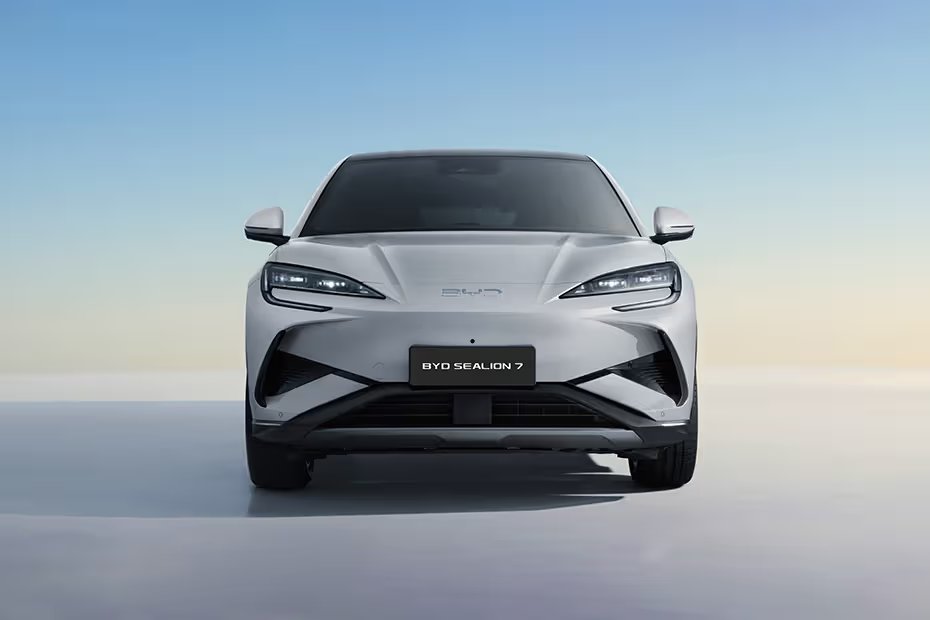
The BYD Sealion 7 is BYD India’s most complete product yet — an electric SUV coupe that spans three variants, two battery sizes, and a dual-motor AWD option, all within the Rs 41.90 lakh to Rs 54.90 lakh ex-showroom range. BYD Sealion 7 price in India 2026 starts at Rs 41.90 lakh for the new Dynamic variant, the most accessible entry point the car has carried since its India launch, and tops out at Rs 54.90 lakh for the Performance dual-motor AWD. In October 2026, BYD added a third option: the Festive Edition, priced at Rs 50.60 lakh, limited to 150 units, and defined by a tan-and-black Nappa leather interior built on the Premium trim base.
This article covers the full variant-wise price breakdown, what separates the Dynamic from the Premium, the Festive Edition’s specific features, real-world and claimed range across all three variants, Blade Battery technology, and a side-by-side comparison with the Hyundai Ioniq 5 — the closest rival at this price point in India’s premium electric SUV segment.
BYD Sealion 7 Variants and Prices — Full 2026 Lineup
The BYD Sealion 7 is available in three trims in India: Dynamic, Premium, and Performance. BYD Sealion 7 variants and prices span Rs 41.90 lakh to Rs 54.90 lakh ex-showroom — a range wide enough to serve both value-conscious EV buyers and performance-focused ones.
| Variant | Battery | Drive | Motor Output | Claimed Range | Ex-Showroom |
|---|---|---|---|---|---|
| Dynamic | 71.8 kWh | RWD | 308 bhp / 380 Nm | 520 km (NEDC) | Rs 41.90 lakh |
| Premium | 82.56 kWh | RWD | 313 hp / 380 Nm | 567 km (NEDC) | Rs 49.90 lakh |
| Performance | 82.56 kWh | AWD | 523 bhp / 690 Nm | 542 km (NEDC) | Rs 54.90 lakh |
All prices ex-showroom India, October 2026. Range figures are NEDC test cycle claims.
The Dynamic uses the smaller 71.8 kWh Blade Battery, while the Premium and Performance both carry the 82.56 kWh pack. The Performance is the only all-wheel drive electric SUV in the lineup — Dynamic and Premium are rear-wheel drive electric SUV configurations with a single rear motor. All three variants share the same core technology: e-Platform 3.0, Cell-to-Body construction, a 15.6-inch rotating touchscreen, panoramic glass roof, Level 2 ADAS, and 11 airbags.
On-road costs run 10-15% above ex-showroom once road tax, registration, and first-year insurance are added. The Dynamic approaches Rs 48-49 lakh on-road in New Delhi. BYD also applied a Rs 50,000 price hike across the range in January 2026 — buyers should confirm current city-specific quotes at the dealership before finalising.
Dynamic vs Premium — Is the Rs 8 Lakh Gap Worth It?
The Dynamic’s 71.8 kWh battery claims 520 km on the NEDC cycle; the Premium’s 82.56 kWh pack claims 567 km. In real-world Indian conditions, that translates to a gap of approximately 30-40 km in practical range. The feature list — rotating touchscreen, panoramic glass roof, Level 2 ADAS, and 11 airbags — is identical on both trims. For buyers who do not need the larger battery or AWD capability, the Dynamic at Rs 41.90 lakh is the stronger value case. The Rs 8 lakh premium for the Standard buys more range and a larger battery, but not more features.
BYD Sealion 7 Festive Edition — What the Limited-Run Model Adds
BYD launched the Sealion 7 Festive Edition on October 12, 2026 at Rs 50.60 lakh ex-showroom — Rs 70,000 above the standard Premium trim. BYD Sealion 7 Festive Edition price is positioned as a premium over the Premium, with production capped at 150 units nationally. It is not a trim upgrade in the traditional sense: the mechanical specification is unchanged from the Premium.
BYD Sealion 7 Festive Edition features one defining change over the standard Premium: a tan-and-black interior theme that covers the dashboard, door cards, seats, and centre console. The Nappa leather upholstery completes the cabin finish. The exterior carries no visual changes — no badging, no colour-specific options, and no design elements that distinguish it from a standard Premium on the outside.
The full confirmed feature list on the Festive Edition: 15.6-inch rotating touchscreen, 10.25-inch driver’s display, panoramic glass roof, electrically adjustable and ventilated front seats, 12-speaker audio, 11 airbags, 360-degree camera, and Level 2 ADAS. Mechanically, it carries the 82.56 kWh Blade Battery, a 313 hp rear-wheel drive electric motor, a 567 km NEDC-claimed range, and a 0-100 kph time of 6.7 seconds.
For buyers who want the Premium spec with a distinctive cabin and can act before the 150-unit allocation runs out, the Rs 70,000 premium is a reasonable ask. The tan-and-black Nappa leather interior is the most characterful cabin the BYD Sealion 7 has offered in India. The constraint is timing — at 150 units, city allocations will be limited.
BYD Sealion 7 Range Per Charge — Claimed vs Real World
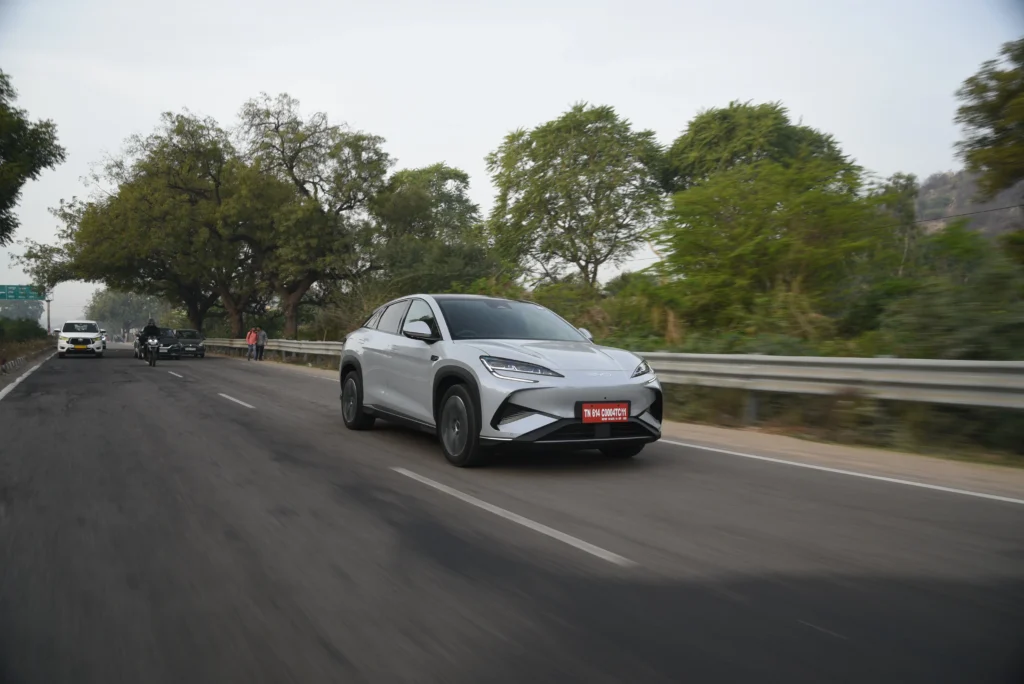
BYD Sealion 7 range per charge varies significantly between the NEDC test cycle figures and real-world results in Indian conditions. BYD publishes three figures for the current lineup:
- Dynamic (71.8 kWh Blade Battery): 520 km claimed range (NEDC)
- Premium (82.56 kWh Blade Battery): 567 km claimed range (NEDC)
- Performance AWD (82.56 kWh Blade Battery): 542 km claimed range (NEDC) — slightly lower than the Premium due to the additional drag from the AWD drivetrain
NEDC figures come from a Chinese laboratory test cycle and do not reflect ARAI-certified range. Real-world BYD Sealion 7 real-world range is lower. CarWale’s controlled test of the Performance AWD variant returned 369 km — approximately 68% of the 542 km NEDC claim. MeraEV’s estimated real-world range for the full lineup runs from 364 km at the low end to 499 km in optimal conditions, depending on variant and usage pattern.
The variables that affect range most significantly on the BYD Sealion 7 in India: air conditioning use (a constant load in Indian summers), sustained highway speeds above 100 kph, city stop-start traffic where regenerative braking recovers energy, and passenger and cargo weight. The Sealion 7 performs better in urban conditions than on constant-speed highway runs because the regenerative braking system recovers energy on every deceleration. A practical planning figure for the Premium in mixed Indian driving is 370-400 km per charge.
The car also supports vehicle-to-load technology (V2L), which lets the battery power external appliances — from a laptop or electric cooler to a power tool — through a standard outlet. For buyers who camp, work outdoors, or face frequent power cuts, this adds genuine utility beyond the car’s driving range.
How to Maximise Real-World Range on the BYD Sealion 7
Eco mode is the starting point for city driving. Pre-conditioning the cabin while still plugged in at home avoids drawing from the battery to cool or heat the interior before departure. Setting regenerative braking to a higher recovery level in urban traffic adds recovered range over a full city commute. For intercity trips beyond 350 km, planning a charging stop is more practical than attempting to complete the journey on one charge. Sustained speeds above 120 kph on the motorway accelerate battery depletion sharply — staying below 100 kph on highway stretches adds meaningful range on longer drives.
BYD Sealion 7 Battery Capacity — Blade Battery Technology Explained
BYD Sealion 7 battery capacity comes in two configurations: the 71.8 kWh Blade Battery in the Dynamic, and the 82.56 kWh Blade Battery in the Premium and Performance. Both packs use BYD’s lithium iron phosphate (LFP) cell chemistry in the blade-shaped cell format that gives the technology its name.
The Blade Battery design uses elongated LFP cells that pack directly into the battery housing without a separate module casing between cells and pack. BYD’s Cell-to-Body construction goes a step further — the battery pack integrates into the vehicle structure, contributing to chassis rigidity, lowering the centre of gravity, and eliminating the weight of traditional module housings. The practical effect is a stiffer body, a lower centre of gravity for handling, and a more efficient use of the space under the floor.
LFP chemistry eliminates cobalt and nickel from the cell composition, which reduces thermal runaway risk compared to NMC chemistry. BYD’s needle penetration test — where a Blade cell is physically pierced without catching fire or exploding — has become a standard demonstration of LFP safety characteristics. For Indian buyers who have read about EV battery fires, this is a relevant data point.
The BYD Sealion 7 supports up to 230 kW peak DC fast charging, completing a 10-80% charge in approximately 24 minutes on a compatible charger. The Hyundai Ioniq 5 supports up to 350 kW and completes 10-80% in approximately 18 minutes — a meaningful gap for buyers who rely on public DC fast charging regularly. For home charging, a 7 kW AC charger — offered free with introductory Dynamic deliveries — brings the 71.8 kWh pack from 0-100% in approximately 10-11 hours overnight. LFP chemistry also retains battery capacity better over a higher number of charge cycles than NMC alternatives, which supports long-term ownership cost and resale value over an 8-10 year ownership horizon.
BYD Sealion 7 vs Hyundai Ioniq 5 — Which Premium Electric SUV Wins?
The BYD Sealion 7 and Hyundai Ioniq 5 occupy the same premium electric SUV bracket in India and attract the same buyer profile. The comparison table below covers the key differentiators between the BYD Sealion 7 Premium and the Ioniq 5.
| Feature | BYD Sealion 7 (Premium) | Hyundai Ioniq 5 |
|---|---|---|
| Ex-Showroom Price | Rs 49.90 lakh | Rs 46.30 lakh (base) |
| Battery Capacity | 82.56 kWh | 84 kWh |
| Claimed Range | 567 km (NEDC) | 631-690 km (ARAI) |
| Motor Power | 313 hp (RWD) | 226 bhp (RWD) |
| Peak DC Charging | 230 kW (10-80% in 24 min) | 350 kW (10-80% in 18 min) |
| 0-100 kph | 6.7 sec | Not published |
| Top Speed | 215 kph | 185 kph |
| Airbags | 11 | 6 |
| V2L Support | Yes | Yes |
| Rotating Touchscreen | 15.6-inch, rotating | 12.3-inch, fixed |
Prices ex-showroom India, October 2026.
The Ioniq 5 leads on charging speed (350 kW vs 230 kW) and certified range — its 631-690 km ARAI-claimed figure uses India’s domestic test cycle, which is more conservative than NEDC, making it a more directly comparable planning figure. The Sealion 7 leads on motor power output (313 hp vs 226 bhp), airbag count (11 vs 6), top speed (215 kph vs 185 kph), and the drama of the Performance variant’s 523 bhp all-wheel drive electric SUV setup. The 15.6-inch rotating touchscreen is the more distinctive piece of cabin technology compared to the Ioniq 5’s 12.3-inch fixed unit. At the entry level, the Dynamic’s Rs 41.90 lakh ex-showroom undercuts the Ioniq 5’s base by Rs 4.40 lakh — with an identical feature set at the core of the cabin.
Tips for BYD Sealion 7 Buyers in India
The Festive Edition has a hard deadline. BYD Sealion 7 Festive Edition production is capped at 150 units. Buyers interested in the tan-and-black Nappa leather interior should confirm city-level availability immediately — at 150 units nationally, dealership allocations in large cities will be single digits.
Check CCS2 charging availability before choosing the Dynamic. The Dynamic at Rs 41.90 lakh with a free 7 kW home charger is the right choice for buyers with dedicated home charging. Buyers who depend primarily on public chargers should map CCS2 fast charger availability on their regular routes before committing. The BYD Sealion 7’s connected car features and Level 2 ADAS suite — part of BYD’s e-Platform 3.0 connected car technology integration — work across all three variants.
AWD is only available at one price point. The all-wheel drive electric SUV configuration is exclusive to the Performance variant at Rs 54.90 lakh. No mid-spec AWD option exists in the current Sealion 7 lineup.
V2L adds practical value for outdoor users. The vehicle-to-load technology on the Sealion 7 powers external appliances from the battery. Most city buyers will not use it regularly, but it adds real resale value for buyers who camp, travel to remote areas, or face frequent power outages.
Calculate on-road in your state, not Delhi. The Dynamic approaches Rs 48-49 lakh on-road in Delhi. Road tax rates vary significantly in Maharashtra, Kerala, and Karnataka — the on-road gap between states can exceed Rs 1-2 lakh on a Rs 41.90 lakh base. Get a city-specific quote before finalising variant choice based on ex-showroom price alone.
FAQ — BYD Sealion 7: People Also Ask
Q1: What is the BYD Sealion 7 price in India 2026? BYD Sealion 7 price in India 2026 starts at Rs 41.90 lakh ex-showroom for the Dynamic variant and climbs to Rs 54.90 lakh for the Performance AWD. The limited Festive Edition sits at Rs 50.60 lakh. BYD applied a Rs 50,000 price hike in January 2026; all figures above reflect current October 2026 pricing.
Q2: What is the BYD Sealion 7 real-world range? BYD Sealion 7 real-world range in controlled Indian conditions tested at 369 km for the Performance AWD (CarWale, November 2025) — 68% of its 542 km NEDC claim. MeraEV estimates 364-499 km across the full lineup depending on variant, speed, and AC usage. A practical planning figure for the Premium in mixed Indian driving is 370-400 km per charge.
Q3: What are the BYD Sealion 7 Festive Edition features? BYD Sealion 7 Festive Edition features include a tan-and-black interior with Nappa leather upholstery across the dashboard, door cards, seats, and centre console. The full equipment list covers the 15.6-inch rotating touchscreen, 10.25-inch driver’s display, panoramic glass roof, electrically adjustable and ventilated front seats, 12-speaker audio, 11 airbags, 360-degree camera, and Level 2 ADAS. The exterior is unchanged from the standard Premium.
Q4: What is the BYD Sealion 7 battery capacity? BYD Sealion 7 battery capacity is 71.8 kWh on the Dynamic and 82.56 kWh on the Premium and Performance. Both use BYD’s Blade Battery technology — an LFP cell chemistry with Cell-to-Body construction that integrates the pack into the vehicle’s structure. The 82.56 kWh pack supports 230 kW DC fast charging with a 10-80% time of approximately 24 minutes.
Q5: How does the BYD Sealion 7 compare to the Hyundai Ioniq 5? BYD Sealion 7 vs Hyundai Ioniq 5: the Sealion 7 leads on motor power (313 hp vs 226 bhp RWD), airbag count (11 vs 6), top speed, and the rotating touchscreen. The Ioniq 5 leads on DC charging speed (350 kW vs 230 kW) and ARAI-certified range. The Dynamic at Rs 41.90 lakh undercuts the Ioniq 5’s base by Rs 4.40 lakh while delivering a comparable feature set.
BYD Sealion 7 2026: More Variants, Sharper Entry Price, One Clear Trade-Off
The BYD Sealion 7 has made its most significant value shift since the India launch. The Dynamic at Rs 41.90 lakh brings Blade Battery technology, 11 airbags, a 15.6-inch rotating touchscreen, Level 2 ADAS, and a panoramic glass roof to a price point that undercuts the Ioniq 5’s base — without removing the technology that defines this BYD electric SUV. That is a meaningful change for a segment where the entry price previously started above Rs 48 lakh.
The Festive Edition is the most visually distinctive version of the Sealion 7 India has seen. The tan-and-black Nappa leather cabin is a genuine design statement, and at 150 units it is a real scarcity play — not a trim badge added to a standard unit. Buyers who appreciate the interior will not find it on any other version of the car.
The one trade-off that does not resolve with a variant choice or a price cut: DC fast charging at 230 kW versus the Ioniq 5’s 350 kW. For home chargers and occasional public charging, 24 minutes to 80% is entirely practical. For buyers who regularly drive 400-plus km between cities and depend on en-route DC fast charging to complete journeys, the Ioniq 5’s 18-minute charge is a concrete advantage that the Sealion 7 does not match in its current spec.