The advancement of connected car technology has altered the way vehicles share and utilize information across various driving conditions. The latest car models can communicate with devices like smartphones, cloud systems, roadside infrastructure, and other vehicles through cellular, Wi-Fi, Bluetooth, or satellite technology. Most new cars carry several electronic control systems and numerous sensors, resulting in a flow of massive amounts of data. Connectivity is now a core part of vehicle design rather than an optional feature. This guide covers how connected car technology works, its safety and maintenance benefits, real-world navigation gains, electric vehicle advantages, V2X communication, and cybersecurity challenges.
What Is Connected Car Technology and How It Works
A connected vehicle operates on the principle of collecting information and then transmitting it. Sensors installed on the vehicle keep track of speed, position, battery condition, tire pressure, temperature, and component performance within milliseconds. In the course of a 2-hour drive, a vehicle can generate millions of discrete data points. Both 4G and the emerging 5G mobile communication systems enable data to travel between vehicles and clouds in near real-time.
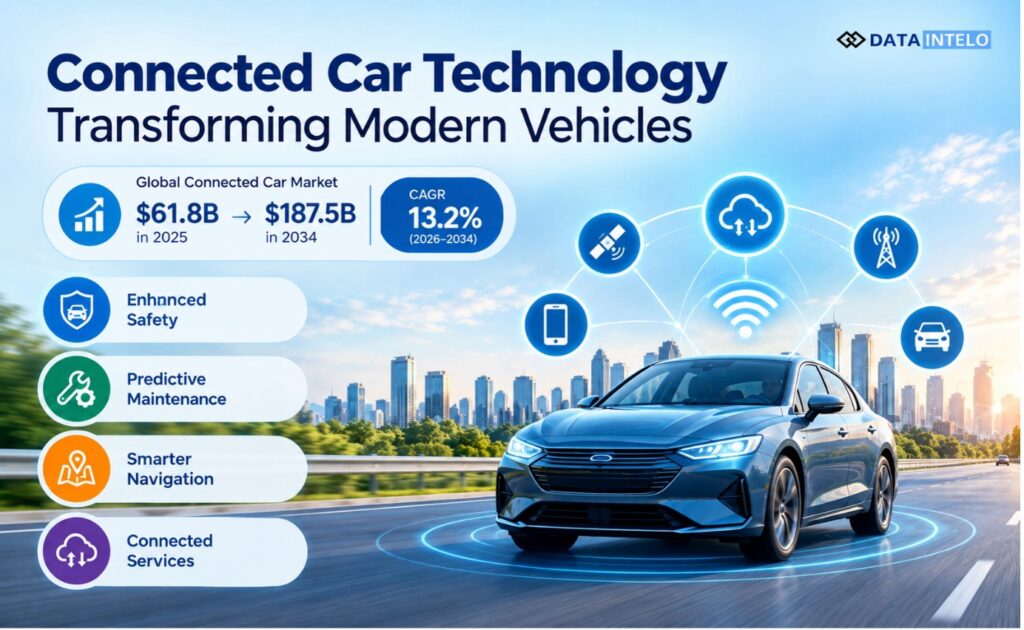
The scale of this shift is visible in market growth. According to Dataintelo, the global connected car market was valued at $61.8 billion in 2025 and will reach $187.5 billion by 2034, registering a CAGR of 13.2% from 2026 to 2034. That growth stems from the deeper integration of connectivity into vehicle systems, digital services, diagnostics, and communication infrastructure. Connected car technology is no longer a luxury segment feature; it is the baseline expectation for any new vehicle entering the market in 2026.
Safety Functions: The Measurable Benefit
Connectivity directly improves safety outcomes. Connected systems exchange alerts regarding sudden braking, traffic jams, road hazards, and weather changes. Receiving a warning two seconds before a potential collision gives the driver a meaningful reaction window at any speed.
At 100 km/h, a vehicle travels 27.8 meters every second. A 2-second advance warning covers 55.6 meters of additional stopping or reaction distance. Vehicle-to-vehicle (V2V) and vehicle-to-infrastructure (V2I) communication layers real-time external data on top of standard driver-assistance systems. These systems do not replace human judgment; they give drivers information they cannot independently obtain at speed.
Predictive Maintenance and Vehicle Health Monitoring
Conventional maintenance schedules run on fixed time intervals, which do not reflect actual vehicle condition. Connected vehicles change this approach. Sensors monitoring vibration, temperature, pressure, and voltage feed live data to onboard diagnostic systems and cloud platforms.
A connected system can detect a 10% rise in operating temperature or a 15% deviation in vibration patterns and trigger a maintenance alert before the fault becomes a failure. Fleet operators benefit most: pinpointing a component at risk before breakdown eliminates unplanned downtime and reduces repair costs. For private owners, predictive maintenance means fewer unexpected workshop visits and better-informed service decisions.
Traffic and Navigation Intelligence
Connected systems transform navigation from a static map application into a live-data service. Real-time traffic, weather, accident reports, and terrain data feed into route calculations dynamically.
For fleet operators, a 5-minute reduction in average trip time across 1,000 vehicles saves more than 83 hours per day. That figure does not come from better maps alone; it comes from the continuous exchange of real-time data across connected vehicles and infrastructure nodes. Private users benefit as well: routes update as conditions change, rather than following a path calculated before the journey began.
In-Vehicle Digital Services and OTA Updates
Modern infotainment extends far beyond audio. Connected systems sync with smartphones, stream cloud-based audio and video, run voice assistants, and receive over-the-air (OTA) software updates. OTA updates allow manufacturers to modify vehicle functions remotely, bypassing the need for a workshop visit on software-related changes. Critical safety systems still require physical validation, but non-safety functions update digitally.
A vehicle receiving four OTA updates annually gains four opportunities for feature additions, bug fixes, or performance calibration without a service appointment. The growing reliance on wireless connectivity also raises the cyber risk profile of every connected car. Each wireless access point represents a potential entry into the vehicle’s control systems.
Connected Electric Vehicles: Battery Management and Range
Electric vehicles rely on connected car technology more than any other vehicle type. Battery management systems monitor current, temperature, voltage, and the charge state of individual cells across the pack in real time. This data feeds into range estimation, charge scheduling, and degradation tracking.
A connected EV with route awareness can calculate the precise charge required for a destination and identify the nearest charging station 20 km away before the driver needs to search. Integration between navigation, battery data, and charging infrastructure is only possible through permanent connectivity. For Indian EV buyers, this translates to reduced range anxiety on long-distance runs and better day-to-day charge planning.
Vehicle-to-Everything (V2X) Communication
V2X technology enables vehicles to communicate with traffic signals, road infrastructure, pedestrian devices, and other vehicles within milliseconds. Applications include receiving phase information from intelligent intersections before signal changes and hazard alerts from vehicles ahead.
V2X communication operates at the millisecond level, fast enough for safety-critical applications at highway speeds. However, widespread V2X deployment depends on infrastructure investment, regulatory alignment, and network coverage that most markets, including India, have not yet achieved at scale. The technology is proven in pilot environments; the rollout timeline varies by country.
Key Developments in Connected Vehicle Technology
| Area | Typical Measurable Development |
|---|---|
| Connectivity | 4G and 5G data links |
| Safety | Warnings delivered within seconds |
| Diagnostics | 10%-15% abnormality detection thresholds |
| Navigation | Traffic updates every 30-60 seconds |
| Software | Around 4 remote OTA updates annually |
| V2X | Millisecond-level vehicle-to-infrastructure communication |
Data Protection and Cybersecurity Challenges
Greater connectivity creates quantifiable cybersecurity exposure. A modern car can carry over 100 electronic control units, multiple wireless interfaces, and several software stacks. Each layer is a potential attack surface.
Key security requirements include authentication and encryption for all data transmissions, continuous monitoring of in-vehicle networks, and secure protocols for OTA software updates. Data privacy sits alongside data security as a separate concern. Location history, driving behaviour, and communication logs accumulate over days, weeks, and months. Manufacturers and service providers must be transparent about what data is collected, how long it is retained, and who can access it. Indian vehicle buyers should check OEM data policies before enabling connected services on their vehicles.
The Road Ahead for Connected Car Technology
Connected car technology is converting vehicles from isolated machines into intelligent, communicating units. Technologies including 5G, edge computing, artificial intelligence, V2X communication, and OTA updates are expanding what connectivity can deliver inside a vehicle.
The central capability in this shift is joining data from multiple networks, sensors, and external infrastructure simultaneously. As the number of connected vehicles grows globally, new challenges will emerge in communication latency, cybersecurity, and data governance. For automakers, competitive differentiation is moving from hardware to software and connectivity. For buyers, the question is no longer whether their next car will be connected; it is how deeply connected, and at what data cost.
FAQs: Connected Car Technology
What is connected car technology?
Connected car technology refers to systems that enable vehicles to communicate with external networks, infrastructure, other vehicles, and digital services using cellular (4G/5G), Wi-Fi, Bluetooth, or satellite connections. These systems collect and share real-time data to improve safety, navigation, maintenance, and in-car services.
How does connected car technology improve safety?
Connected systems relay alerts about sudden braking, hazards, and road conditions from other vehicles or infrastructure within seconds. At 100 km/h, a 2-second advance warning adds 55.6 meters of reaction distance. V2V and V2I communication layers this data on top of onboard driver-assistance systems.
What is the connected car market size?
According to Dataintelo, the global connected car market was valued at $61.8 billion in 2025 and is projected to reach $187.5 billion by 2034 at a CAGR of 13.2%. Growth is driven by deeper integration of connectivity, cloud services, and diagnostics across all vehicle segments.
What are the cybersecurity risks of connected cars?
Modern connected vehicles carry over 100 ECUs and multiple wireless access points. Each connection is a potential entry point for cyberattacks. Risks are managed through authentication and encryption, continuous network monitoring, and secure OTA update protocols. Data privacy is a separate concern involving the storage and access of location and driving data.
How does connected car technology benefit electric vehicles?
EVs depend on connected car technology for battery management, range estimation, and charge planning. Real-time battery data combined with route awareness allows the vehicle to locate charging infrastructure proactively and calculate exact charge requirements, reducing range anxiety for daily and long-distance use.