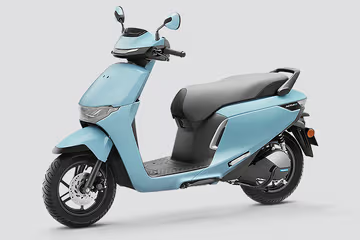
Honda has unveiled the QC3 electric scooter in India, its third electric two-wheeler after the QC1 and the Activa e:. This Honda QC3 electric scooter unveiled in India marks Honda’s clearest attempt yet at a genuinely long-range electric scooter, carrying a bigger 3kWh battery than the QC1, a 145km IDC-claimed range, and Honda RoadSync connectivity built around a 5-inch TFT display.
Honda has unveiled the scooter, not launched it, so pricing and the launch date remain estimates for now, and this article flags every one of those estimates clearly rather than presenting them as settled.
Honda QC3 Electric Scooter Specifications — What’s Confirmed So Far
Honda has confirmed a 3 kWh battery pack on the QC3, a genuine step up from the QC1’s smaller unit. Autocar India describes the QC1’s pack as a fixed 1.5kWh battery, while BikeWale lists it as 1.8kWh — the two outlets disagree on this specific figure, so treat the QC1 comparison as approximate rather than exact.
Charging on the QC3 runs 0-80% in 2 hours 40 minutes on the fast charger, with a full charge taking around 4 hours. Underseat storage measures 32 litres, six litres more than the QC1’s 26-litre bay. The front gets a telescopic fork, the rear runs dual shocks, and braking comes from a front disc paired with a rear drum. Together, this Honda QC3 battery range and features package reads as a genuine upgrade over the QC1 rather than a cosmetic refresh.
Honda QC3 Battery and IDC Claimed Range
Autocar India, ZigWheels, and BikeDekho all independently list the Honda QC3 electric scooter 145 km range figure on the IDC test cycle, drawn from the 3kWh pack. One outlet, EVINDIA, headlines a 151km figure while its own body text states 145km — that internal contradiction, combined with the site not being corroborated elsewhere in this research, means the 145km figure from Autocar India, ZigWheels, and BikeDekho is the one to trust.
IDC-claimed range works the same way ARAI-certified mileage does for petrol scooters: it’s a lab figure, not a promise. Riders should expect real-world numbers to land meaningfully below 145km once traffic, rider weight, and accessory use enter the picture.
Three Displays, One Honda RoadSync — Features That Actually Matter
The QC3’s 5-inch TFT display runs Honda RoadSync, bundling Bluetooth connectivity, turn-by-turn navigation, and call and SMS alerts into one screen. A smart key handles keyless start, and a USB charging port sits within easy reach for a phone on the move. This mirrors the connected-scooter approach Honda has been building across its electric lineup, rather than a one-off feature bolted on for the QC3 specifically.
None of this is groundbreaking on its own — every serious rival now ships app connectivity and a colour display as standard. What separates useful from decorative here is whether Honda RoadSync’s navigation and alerts function stays reliable in daily use, since a notification screen that lags or drops connection defeats the purpose entirely. Keyless start and USB charging earn their keep regardless; they’re the kind of features riders notice the day they’re missing, not just the day they’re present.
Honda hasn’t detailed whether the QC3 gets ride modes or regenerative braking settings, both common on rivals in this price bracket. That’s another gap to watch closing once the official spec sheet lands closer to launch.
Honda QC3 vs QC1 vs Activa e: — Don’t Mix These Up
Honda electric scooter searches routinely lump these three models together, and they shouldn’t be. The QC1 sits at the bottom of Honda’s electric range, priced from ₹90,708, running a fixed battery (1.5kWh per Autocar India, 1.8kWh per BikeWale) for roughly 80km of IDC-claimed range. It’s the cheapest and simplest of the three.
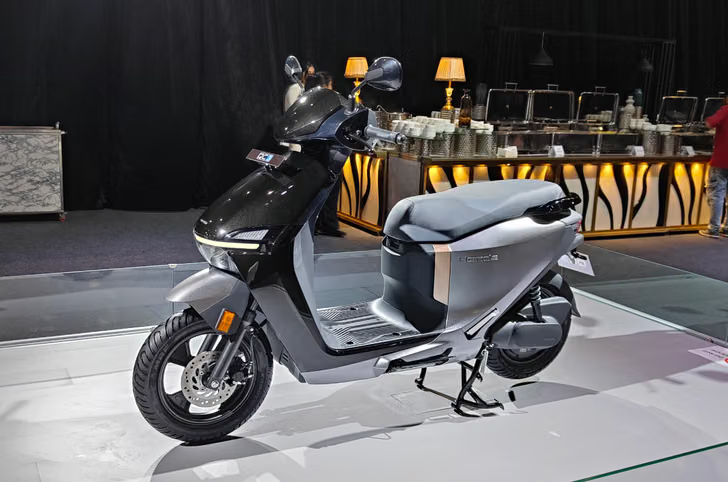
The Activa e: sits above it, using two removable 1.5kWh battery packs for a combined 3kWh capacity and a 102km IDC-claimed range, priced from ₹1.20 lakh. Its removable-pack design suits riders without home charging access, since the batteries can be swapped at a station rather than plugging the whole scooter in. The Honda QC3 electric scooter arrives with a single fixed 3kWh pack and the longest claimed range of the trio at 145km, positioned above the QC1 and likely close to or above the Activa e: once actual pricing lands.
These are three separate products built for three different budgets, not trim levels of a single scooter. Anyone specifically hunting for an upcoming Honda electric scooter with the longest range currently disclosed lands squarely on the QC3, while anyone prioritising removable-battery convenience over outright range should look at the Activa e: instead.
Honda QC3 Launch in India — Date and Price Expectations
Honda has unveiled the QC3, not launched it, and every date or price attached to it right now is an estimate. The Honda QC3 launch date spread across sources is genuinely wide: BikeWale estimates October 2026, ZigWheels points to around December 2026, and BikeDekho commits only to “by the end of 2026.” These aren’t rounding differences — they’re three separate guesses, and none of them is Honda’s own confirmed date.
Price estimates split into two camps too. BikeWale pegs the Honda QC3 electric scooter at ₹1,25,000-1,30,000, while ZigWheels and BikeDekho independently estimate closer to ₹1.20 lakh ex-showroom. Treat both ranges as live possibilities rather than averaging them into one invented number. Motor output and top speed remain completely undisclosed as of the unveiling — Honda hasn’t published a full Honda QC3 specifications sheet covering performance yet, and no figure here should be estimated or inferred ahead of that release.
Honda QC3 Electric Scooter vs the Competition
Since the QC3 hasn’t launched, this comparison shows how its expected specs stack up against scooters Indian buyers can actually walk into a showroom and buy today, not a completed head-to-head test. Electric two-wheelers in India have gotten genuinely competitive on range and charging speed over the past two years, and the QC3’s numbers need to hold up against that bar, especially in the crowded electric scooter India segment sitting between ₹1 lakh and ₹1.5 lakh.
| Scooter | Battery | IDC-Claimed Range | Fast Charge (0-80%) | Ex-Showroom Price (Starting) |
|---|---|---|---|---|
| Honda QC3 (expected) | 3kWh | 145 km | 2h 40m | ₹1.20-1.30 lakh (estimated) |
| Bajaj Chetak 3501 | 3.5kWh | 153 km | 3h 00m | ₹1.35 lakh |
| TVS iQube ST (3.5kWh) | 3.5kWh | 145 km | ~4h 00m | ₹1.49 lakh |
| Ather Rizta S | 2.9kWh | 123 km | ~5h 20m | ₹1.21 lakh |
| Hero Vida VX2 Plus (3.4kWh) | 3.4kWh | 142 km | ~4h 10m (full) | ₹99,490 |
Note: the Vida VX2 Plus name covers more than one battery size — a smaller-pack variant starts near ₹94,800 street price, while a larger 4.4kWh version runs up to ₹1,50,990. Don’t collapse these into a single figure when quoting VX2 Plus pricing. Ather Rizta pricing also varies by city, typically ₹1.21-1.28 lakh depending on location.
On paper, the QC3’s charging speed is genuinely its strongest card — 2 hours 40 minutes beats every rival listed here. Its 145km claimed range matches the iQube ST exactly and sits close behind the Chetak 3501’s 153km, all while carrying a smaller 3kWh pack than either. That efficiency is worth watching once real IDC-versus-real-world gaps become clear after launch.
Tips for Buyers Considering the Honda QC3
- Don’t book on unveiling hype alone — Honda hasn’t confirmed final pricing, and the QC1’s own rollout shifted city by city rather than launching nationwide on day one
- Expect real-world range to run 15-25% below the claimed 145km once AC-less summer riding, pillion load, and city traffic enter the picture
- Compare underseat storage and charging time directly against the Chetak, Rizta, or iQube if any of those already sit on your shortlist — don’t delay a purchase waiting on the QC3 if you need a scooter now
- Ask the dealership specifically about service network reach in your city, since Honda’s EV rollout through HMSI has been phased rather than available everywhere immediately
- Wait for official motor output and top speed figures before comparing performance claims against rivals, since Honda hasn’t published either yet
- Factor resale value into the decision too — Honda’s petrol-scooter reputation for reliability doesn’t automatically transfer to its electric lineup, since the QC1 and Activa e: are still too new to have established a track record
Frequently Asked Questions
1. What is the price of the Honda QC3 electric scooter in India?
Pricing isn’t confirmed yet. BikeWale estimates ₹1,25,000-1,30,000, while ZigWheels and BikeDekho estimate closer to ₹1.20 lakh ex-showroom — both remain projections until Honda announces an official figure.
2. What is the range of the Honda QC3 electric scooter?
Autocar India, ZigWheels, and BikeDekho all cite a 145km IDC-claimed range on the 3kWh battery pack, making it the longest-range scooter in Honda’s current electric lineup.
3. When will the Honda QC3 launch in India?
No confirmed date exists yet. Estimates range from October 2026 (BikeWale) to around December 2026 (ZigWheels), with BikeDekho stating only “by the end of 2026.”
4. What are the specifications of the Honda QC3?
A 3kWh battery, 145km IDC-claimed range, 2h40m fast-charge time to 80%, 32-litre underseat storage, a 5-inch TFT display with Honda RoadSync, telescopic front fork, dual rear shocks, and disc-front/drum-rear brakes. Motor output and top speed remain undisclosed.
5. Is the Honda QC3 different from the Honda QC1?
Yes. The QC1 is the cheaper, entry-level model with a smaller fixed battery and around 80km of range, while the QC3 uses a larger 3kWh pack for a claimed 145km — two distinct products, not two trims of the same scooter.
The Verdict on Honda’s Third Electric Scooter
The Honda QC3 electric scooter looks like a real step up over the QC1 on paper: a bigger battery, genuinely usable range, faster charging than most direct rivals, and connected features that actually add convenience rather than just checking a spec-sheet box. None of that guarantees success once it reaches showrooms.
Honda’s pattern with two-wheelers has leaned toward premium pricing more often than aggressive value, and that habit is the real risk here. Whether Honda prices the QC3 close to the Chetak and iQube or well above them will decide if this becomes a genuine mass-market contender or a scooter that impresses on a spec sheet while losing buyers to cheaper, already-available alternatives. For now, the Honda QC3 electric scooter remains a strong promise waiting on a price tag to prove it.
For further reading, check Honda’s official two-wheeler India site for confirmed announcements as they happen, and see Autocar India’s coverage of the QC3 unveiling for ongoing specification updates. Readers comparing electric scooters already on sale can also browse our full lineup of electric two-wheeler reviews for models available to buy right now.