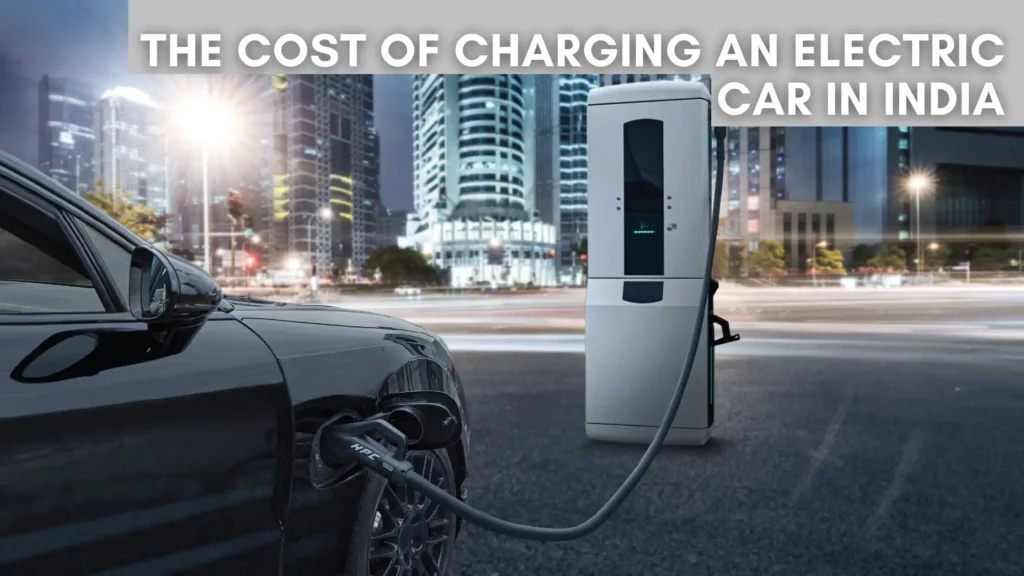
Petrol prices in India crossed ₹100 per litre in several cities, and fuel costs now eat a significant portion of a household’s monthly budget. This financial pressure has pushed lakhs of Indian car buyers toward electric vehicles — and the first question they ask is: what is the actual electric vehicle charging cost? Understanding this number is no longer optional; it determines the true value of switching to an EV. This article breaks down every aspect of EV charging expenses, from home setups to public networks, helping Indian buyers make a fully informed decision.
The ev charging cost in india is not a single number — it varies by state electricity tariffs, charger type, vehicle battery capacity, and charging network. This guide covers all of these variables in plain language, with real figures, real network names, and an honest comparison against petrol and CNG running costs.
How Is Electric Vehicle Charging Cost Calculated?
The formula behind electric vehicle charging cost is straightforward:
Cost = Battery Capacity (kWh) × Electricity Tariff (₹/unit)
For example, the Tata Nexon EV has a 30.2 kWh battery. At a home electricity tariff of ₹7 per unit (common in Maharashtra and Karnataka), a full charge costs approximately ₹211. The MG ZS EV (50.3 kWh battery) costs around ₹352 at the same tariff. The BYD Atto 3, with a 60.48 kWh battery, costs close to ₹423 per full charge at home.
State Electricity Board (SEB) tariffs across India range from ₹5 per unit in states like Madhya Pradesh to ₹9 per unit in parts of Tamil Nadu and Maharashtra for domestic consumers. A vehicle’s real-world efficiency — measured in km per kWh — also influences the per-kilometre cost. The Tata Nexon EV delivers approximately 5–6 km per kWh in real-world conditions, making its effective per-km cost ₹1.2–₹1.4 at a ₹7 tariff.
Key Factors That Affect Electric Vehicle Charging Cost
Several variables determine how much an EV owner pays per charge:
- Battery capacity: Larger batteries (40–72 kWh) cost more per full charge but typically deliver more range per session. The Hyundai Ioniq 5 (72.6 kWh) and Kia EV6 (77.4 kWh) are premium examples with higher per-charge costs.
- State electricity tariff: Maharashtra, Delhi, and Karnataka offer preferential EV tariffs (₹5–₹6/unit for EV-specific connections), which significantly reduces electric vehicle charging expenses.
- Ev charger type: Level 1 (slow), Level 2 (AC wall box), and Level 3 (DC fast) chargers consume electricity at different rates and speeds.
- Time of charging: Several discoms offer time-of-use (ToU) tariffs — charging between 11 PM and 6 AM can reduce per-unit cost by 20–30%.
Section Summary: The base cost formula is simple — battery size multiplied by the local electricity tariff. A Tata Nexon EV costs ₹200–₹220 for a full home charge, while larger EVs like the BYD Atto 3 cost ₹400–₹430 at the same tariff.
EV Charging Cost in India: Home Charging vs. Public Charging
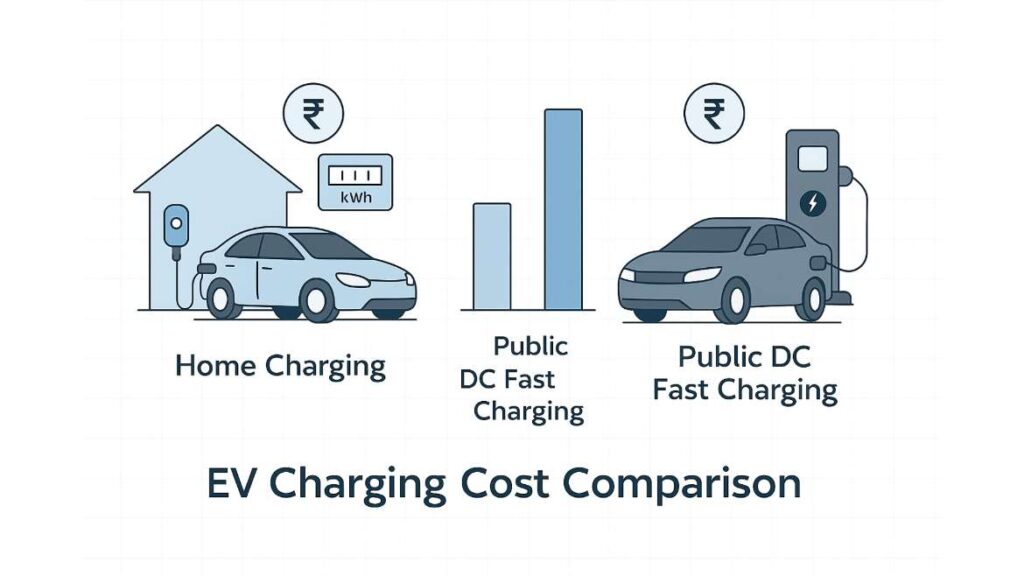
For the majority of Indian EV owners, two charging scenarios define daily ownership — home charging and public station charging. The ev charging cost in india differs considerably between these two settings.
Home charging uses either a standard 15A domestic socket or a dedicated Level 2 AC wall box charger. At domestic tariffs of ₹5–₹9 per unit, home charging delivers a running cost of approximately ₹1.5–₹2 per kilometre, making it the most economical option by a wide margin. The Tata Nexon EV, India’s best-selling electric car, covers roughly 250–300 km on a full home charge at a cost of under ₹250.
Public charging at networks like Tata Power EZ Charge, ChargeZone, Statiq, and BPCL/HPCL Pulse charges ₹15–₹25 per unit, depending on location and charger speed. This is 2–4x higher than home electricity rates, raising the per-km cost to ₹2.5–₹3. The ev charging cost in india at public DC fast chargers on national highways (NH-48, NH-44) frequently reaches ₹20–₹24/unit.
States like Maharashtra and Karnataka have introduced dedicated EV tariff categories — as low as ₹5/unit — which incentivises installation of home chargers and reduces dependence on costly public infrastructure.
Home Charging Cost Breakdown
Installing a Level 2 AC electric car charger (3.3 kW or 7.2 kW) at home costs between ₹8,000 and ₹20,000, depending on brand and installation requirements. Tata Motors, MG Motor, and Hyundai each offer subsidised charger installation as part of their EV purchase packages for their respective models.
Monthly electricity bill impact for an average Indian driver covering 1,500 km/month: the Nexon EV consumes roughly 250 kWh/month, adding ₹1,250–₹2,000 to the electricity bill depending on the state tariff slab. The best practice: use the ev charger‘s built-in timer to schedule overnight charging when tariffs are lowest.
Public Charging Cost Breakdown
Public charging stations in India use two pricing models: per-unit (₹/kWh) and per-minute. Tata Power EZ Charge bills per unit (₹18–₹22/unit), while some older ChargeZone stations used per-minute billing — a model being phased out because it penalises slower vehicles.
Malls and tech parks in cities like Pune, Bengaluru, and Gurugram often add a ₹30–₹80 session fee or a parking surcharge on top of charging costs. Highway stations operated under the FAME II scheme may have subsidised rates. Ev charging stations cost in india at AC stations along metro corridors tends to be ₹15–₹18/unit, while highway DC fast charging runs ₹20–₹25/unit.
Section Summary: Home charging keeps running costs between ₹1.5–₹2/km, while public network charging raises that to ₹2.5–₹3/km. For daily commuters, home charging is the primary cost benchmark; public stations serve long-distance needs.
EV Charging Station Cost in India: A State-Wise Overview
Ev charging stations cost in india varies meaningfully across geographies. Metro cities benefit from denser public infrastructure and government-subsidised charging points, while Tier-2 cities are catching up under the FAME II scheme, which targets 7,432 EV charging stations nationwide.
Delhi’s state government has established EV-friendly charging rates (₹5/unit for registered EVs at select BSES and Tata Power points). Mumbai hosts one of India’s largest charging networks via Tata Power, with AC and DC stations across residential complexes and commercial hubs. Bengaluru, home to a large EV-aware tech-worker demographic, offers competitive electric vehicle charging station cost at Ather Grid, ChargeZone, and BESCOM-facilitated stations.
Highway corridors — NH-48 (Delhi–Mumbai), NH-44 (Delhi–Chennai), and NH-8 (Delhi–Jaipur) — now carry DC fast charging stations every 50–100 km, making long-distance EV travel viable. The electric vehicle charging station cost at these highway fast chargers (30 kW–60 kW) ranges between ₹18–₹25 per unit.
Top EV Charging Networks in India and Their Rates
India’s major ev charging stations cost providers:
- Tata Power EZ Charge: ₹18–₹22/unit at AC stations; ₹22–₹25/unit at DC fast points. Widest network in residential complexes across Mumbai, Pune, and Delhi NCR.
- ChargeZone: ₹15–₹20/unit; monthly subscription plans available from ₹999/month for frequent users.
- Ather Grid: Primarily for Ather 450X scooters but compatible with CCS2-equipped cars; ₹18/unit at fast points.
- Statiq: ₹16–₹22/unit; strong presence in Delhi NCR, Chandigarh, and Lucknow.
- BPCL/HPCL Pulse: Available at fuel station forecourts; ₹20–₹24/unit; accepts BHIM UPI natively.
Section Summary: Delhi and Bengaluru offer the lowest ev charging stations cost in india due to state subsidies. Highway DC charging at ₹20–₹25/unit is the most expensive access point but enables long-distance mobility.
Types of EV Chargers and Their Impact on Cost
The type of ev charger used directly determines both the time and the cost of each charging session. India’s EV ecosystem supports three charger levels.
Level 1 (Slow Charging): A standard 15A socket delivers roughly 2.2 kW. A 40 kWh battery takes 16–18 hours for a full charge. At ₹7/unit, cost per session = ₹280. Best for plug-in hybrids like the Toyota Urban Cruiser Hyryder or for overnight top-ups with short daily drives.
Level 2 (AC Wall Box): A dedicated electric car charger delivering 3.3 kW–7.2 kW. Charges a 40 kWh pack in 5–8 hours. Uses the same home electricity tariff as Level 1, but is more efficient and generates less heat stress on the battery. This is the recommended daily driver setup for most Indian EV buyers.
Level 3 (DC Fast Charger): Delivers 30 kW–150 kW. Charges an EV from 20% to 80% in 30–45 minutes. The Tata Nexon EV (2024 facelift) supports 50 kW DC fast charging; the BYD Atto 3 supports 80 kW DC; the Hyundai Ioniq 5 supports 220 kW ultra-fast charging. Cost: ₹18–₹25/unit at public stations.
DC Fast Charger (Level 3) — Is It Worth the Cost?
The fast car charger delivers unbeatable speed but at a premium. A full charge on the Nexon EV at a 50 kW DC station costs ₹544–₹756 — nearly 3x the home charging cost for the same battery. For highway travel or emergency top-ups, the fast car charger is indispensable. For daily urban use, it adds unnecessary cost and — if used exclusively — can accelerate battery degradation over time.
Section Summary: Level 2 wall box chargers offer the best balance of speed and cost for Indian home users. DC fast chargers suit highway and fleet use but cost significantly more per session.
EV Charging Cost vs. Petrol/CNG: How Much Does India Save?
On a cost-per-km basis, the difference between EVs and ICE vehicles in India is significant:
- Petrol car (Maruti Suzuki Swift, 22 km/litre at ₹105/litre): ~₹4.8/km
- CNG car (Maruti Suzuki Ertiga CNG, 26 km/kg at ₹90/kg): ~₹3.5/km
- EV (Tata Nexon EV, home charging at ₹7/unit): ~₹1.4/km
An Indian driver covering 15,000 km/year saves approximately ₹50,000–₹60,000 annually on fuel by switching from petrol to an EV charged at home. The electric vehicle charging cost advantage compounds over time: at 5 years, gross savings exceed ₹2.5 lakh before accounting for lower maintenance costs (no oil changes, fewer brake replacements due to regenerative braking).
The battery replacement cost is a valid long-term concern. Most EV manufacturers in India offer 8-year/160,000 km battery warranties. After warranty expiry, replacement packs cost ₹2–₹4 lakh. Even factoring in this cost, ev car charging cost in india over a 10-year ownership period remains considerably lower than equivalent petrol spending.
Section Summary: EV ownership saves Indian drivers ₹50,000–₹60,000 annually on fuel. Battery replacement is a long-term cost, but 8-year warranties mitigate near-term risk.
EV Charging Cost Comparison: Home vs. Public vs. Fast Charging in India
The table below compares ev charging stations cost in india across all three charging types, using a 40 kWh battery as the reference vehicle:
| Parameter | Home Charging (Level 1/2) | AC Public Charging (Level 2) | DC Fast Charging (Level 3) |
|---|---|---|---|
| Charger Type | 15A Socket / Wall Box | AC Station | DC Fast Charger |
| Charging Time | 8–12 Hours | 3–6 Hours | 30–60 Minutes |
| Cost per Unit | ₹5–₹9 (home tariff) | ₹15–₹20 per unit | ₹18–₹25 per unit |
| Cost per Full Charge (40 kWh) | ₹200–₹360 | ₹600–₹800 | ₹720–₹1,000 |
| Cost per km (approx.) | ₹1–₹1.5 | ₹2–₹2.5 | ₹2.5–₹3 |
| Availability | Home only | Malls, offices, parking | Highways, fast hubs |
| Installation Cost | ₹5,000–₹20,000 | Free (pay per use) | Free (pay per use) |
| Best For | Daily commuters | Office/Mall visits | Long-distance travel |
Data reflects 2024 network pricing from Tata Power EZ Charge, ChargeZone, and Statiq. The electric vehicle charging station cost varies by city and network; figures above represent typical metro-city ranges.
Practical Tips to Reduce EV Car Charging Cost in India
Reducing ev car charging cost in india takes minimal effort with the right habits:
- Charge at home overnight. Most state discoms offer lower ToU tariffs between 11 PM and 6 AM. Setting the ev charger timer saves 15–30% on electricity cost monthly.
- Install a Level 2 wall box. A 7.2 kW electric car charger charges faster, generates less heat stress on the battery, and is more energy-efficient than a standard 15A socket.
- Limit DC fast charging to highways. The fast car charger is a premium service — overuse raises monthly charging bills and may affect long-term battery health. Manufacturers like Tata and MG recommend keeping DC fast charging to under 2–3 sessions per week.
- Subscribe to a charging network plan. ChargeZone and Statiq offer subscription plans (₹999–₹1,999/month) that cut per-unit rates by 15–25% for frequent public charger users.
- Monitor your state EV tariff. Karnataka, Maharashtra, and Delhi have active EV tariff policies — registering for the EV-specific tariff with the local discom can reduce home charging cost by ₹1–₹2 per unit.
- Use the OEM app. Tata Motors’ Tata EV app and MG’s iSMART app track real-time charging sessions, spending history, and nearest public stations — helping owners optimise every rupee spent on charging.
- Enable regenerative braking. Every deceleration feeds energy back into the battery, extending range and reducing the number of full charge cycles needed per month.
Frequently Asked Questions About EV Charging Cost in India
Q1: What is the average ev charging cost in India per km?
The average ev charging cost in india works out to ₹1–₹2 per km for home charging and ₹2–₹3 per km at public stations. In comparison, petrol cars in India cost ₹4.8–₹6/km at current fuel prices. On a 15,000 km/year driving pattern, home EV charging costs roughly ₹15,000–₹22,500 annually versus ₹72,000–₹90,000 for petrol.
Q2: What is the electric vehicle charging station cost for a full charge?
The electric vehicle charging station cost for a full charge depends on the vehicle’s battery capacity. For a 40 kWh EV (Tata Nexon EV Long Range, MG ZS EV Standard), a session at a public AC station costs ₹600–₹800, while a DC fast charge costs ₹720–₹1,000. Home charging the same battery costs ₹200–₹360. Larger batteries like the 60 kWh BYD Atto 3 cost proportionally more per session.
Q3: Which electric car charger is best for home use in India?
A Level 2 AC wall box electric car charger rated at 3.3 kW or 7.2 kW suits most Indian home users. It charges a 40 kWh battery in 5–8 hours, costs ₹8,000–₹20,000 to install, and is gentle on battery chemistry compared to DC fast chargers. Tata, Hyundai, MG, and BYD all offer brand-specific wall box units with their EVs, often bundled with subsidised installation.
Q4: How much does it cost to install a home EV charging point in India?
Installing a dedicated home ev charger costs ₹5,000–₹20,000, depending on the charger’s power rating, brand (Exicom, Tata Power, Delta, ABB), and the complexity of the electrical connection. Tata Motors, MG Motor, and Hyundai India each offer subsidised or complimentary installation packages with qualifying vehicle purchases in 2024.
Q5: Is EV charging free at any stations in India?
Select stations do offer free electric vehicle charging — primarily those set up inside premium residential complexes, corporate campuses, and select hotels. Tata Motors offered a limited-period free public charging benefit with early Nexon EV deliveries. Some shopping centres in Bengaluru and Pune offer complimentary AC charging for customers. However, free public charging is not systematically available and should not be relied on for regular use.
Conclusion: Is the Electric Vehicle Charging Cost Worth It for Indian Buyers?
The verdict is clear: electric vehicle charging cost in India is 3–5x lower per kilometre than petrol, and roughly 2x lower than CNG, making EVs the most economical daily driver for Indian buyers who have home charging access. The initial investment — vehicle price plus ₹8,000–₹20,000 for a home charger — pays back in fuel savings within 2–3 years for most commuting patterns.
Ev car charging cost in india at public stations is higher but still cheaper than petrol on a per-km basis. As India’s FAME II-backed charging network expands and private operators like Tata Power, ChargeZone, and Statiq add more stations, ev charging stations cost is expected to grow more competitive through increased supply and network-level pricing pressure.
Indian buyers considering EVs in 2024–2025 should calculate their personal charging cost using their state’s domestic electricity tariff and their vehicle’s kWh/km efficiency. The Tata Nexon EV, MG ZS EV, BYD Atto 3, and Hyundai Ioniq 5 all represent proven options across price segments. Before purchasing, checking nearest electric vehicle charging infrastructure — both public stations and home installation feasibility — remains the most practical first step toward a cost-efficient EV ownership experience.